If you’re on Chinese social media, you might be seeing things this:
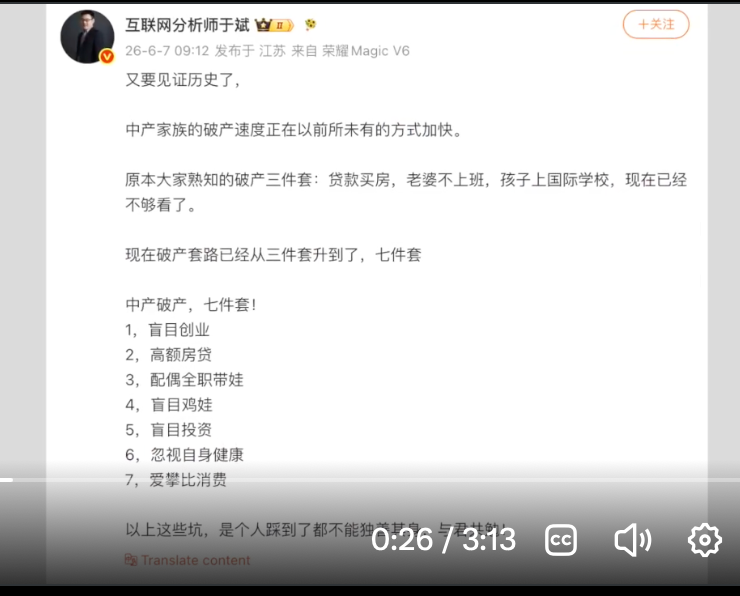
The 7 mistakes ("中产破产七件套"):
盲目创业 — Reckless entrepreneurship/starting a business blindly
高额房贷 — Excessive mortgage debt
配偶全职带娃 — Spouse quitting work to be a full-time parent
盲目鸡娃 — Blindly over-investing in kids' education ("chicken-blood parenting")
盲目投资 — Reckless/blind investing
忽视自身健康 — Neglecting personal health
爱攀比消费 — Status-driven, comparison-based spending
Literally the opposite of 7 Habits for Highly Effective People. LOL! But it’s not really that funny in real life. These mistakes are the result of a work ethic that chases money and status at all costs.
Two quick anecdotes from my work experience in China.
First, “You can’t give them negative feedback.”
After working in China for so many years and then getting a PhD and an MBA, I get requests from many Chinese entrepreneurs to give them feedback on their initial pitch to foreign investors. They want to know what a foreigner thinks about their business “plan.” At least that’s what they tell me they want.
Actually, what they’re looking for is a pat on the back, an introduction to a potential investor, and some shallow positive comments on how well I think they’ll do in their new venture.
Of course, I don’t tell them that. From an American perspective, I’m focused on telling them what they’re missing in the “plan.” And yes, the scare quotes are necessary, in my experience very few really have a developed plan—usually just a cool product idea, a factory connection, and a potential buyer.
I will compliment good ideas, but I’ve never seen a plan with any firm financials, a strategy beyond their first client, a supply-chain plan, or manufacturing cost details. I point out these issues and Chinese entrepreneurs usually leave embarrassed and angry that I’ve made them lose face. My office manager has told me a dozen times, “You can’t give them negative feedback. They don’t really want to know if you think it will work. They just need to let others see that they got foreign approval.”
Now this isn’t everyone, but the Chinese entrepreneurial space is wildly different from the Western one. While Western investors may not going to go through your plan with a fine-toothed comb, they do need the security of seeing that you’ve done your homework. China, though, works on speed and connections—do we have a product (concept), a buyer, and a supplier? If so, we need to jump on this now and worry about details later; if we have those things, it’s likely that there are dozens of others in China who also already have the same.
In the West, the name of the game is preparation and then regular positive returns. In China, the game is bringing proof of concept to market first. Period. Profits, if they ever do come, comes later, when you’ve been bought out or been around long enough to prove that you can get government support to keep going.
This is a high stress, high speed environment that rewards momentum over efficiency.
Second, “My daughter and my liver thank you.”
As a teetotaler, I was the odd business partner for many Chinese factories. Many salesmen were not sure how to deal with someone who both speaks Mandarin and has studied the culture, but at the same time doesn’t engage in evening drinking, banquets, and Karaoke. Usually after an order or two, they get used to me and say something like, “We weren’t sure about you at first, but now we know you’re a good customer.”
The background behind this is the 24/7 nature of business in China. If there is work to be done, you do it. If you don’t, someone else will take the opportunity from you. During the 15 years I was living in China, the government instituted national holidays, 1 day a week weekends; then two. But regardless of the time of year (other than Chinese New Year), I would get calls at 3 a.m. on a Sunday to go fix issues or approve projects in factories—they can’t wait 5-6 hours for the morning, and they are even less willing to wait until Monday! That’s almost 4 missed shifts!
Sure, China Speed is impressive and it’s great when you only have to deal with it irregularly. But think about what that pressure means for the Chinese who are living it! It’s literally deadly.
The Chinese business environment is cutthroat. It’s high speed (“China speed”). And it’s full on, all the time. For people that don’t have a cultural excuse to step away on weekends, it can be physically and emotionally devastating. Divorce, alcoholism, stress, ulcers, and a constant chasing of “next.”
I managed projects at one factory regularly for over a decade. Same project manager. We became pretty good friends over the years. At first, he didn’t believe me when I told him to just take me to KFC instead of a fancy banquet or that I don’t drink or that I’m not interested in Karaoke (hostesses). But after a couple of orders, he realized I was telling him the truth. After a few projects (more than a year), his daughter would meet us at KFC, and I’d help her with her English homework. After a few years and her high school graduation, he confided in me, “My daughter and my liver thank you.”
Because of me as his client, he would get a few nights a month “off.” Meaning he didn’t have to take clients out to drink and he could go home and spend time with his daughter. (His wife was working full time in another office in the same factory.) He told me that because of his time with me, he and his wife had talked many times about how to set rules and limits for their own personal behavior. He had, like most salesmen in China, serious liver issues from years of “business dinners” with clients and says that he would have missed most of his daughter’s childhood too if not for our many projects.
In the recent economic slump (since 2018, really) many of my Chinese friends have asked how they can come work in the US, or how to get their kids out of the Chinese system. It’s not an exaggeration to say that anyone in China with money has left or has plans to leave.
These seven mistakes are almost all results of this high-speed, low-efficiency, max-stress, relationship-dependent, 24/7 churn, that is the China miracle of the last three decades. It’s real, it’s brutal, and it destroys lives. And it’s also systemic due to GDP and other growth-at-any-cost targets set by national and local level governments (i.e. investors). And at a personal level, it is unsustainable physically and emotionally.
In my China experience, it’s not just a meme; these are generational mistakes that cost many people their physical, emotional, financial, social, and/or professional lives.
Member discussion: